
3 BEDROOMS | 3 BATHROOMS | 2,776 SQUARE FEET | 19,602 SF LOT | BUILT 1912 | Sold for $975,000
— • —
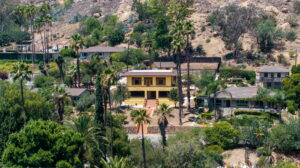
Built in 1912, the LeRoy Simms Residence is a rare example of Southern California Prairie Architecture. It is located in the Mount Rubidoux Historic District and was designed by the district’s most prolific architect, Lester S. Moore. As a member of the A.I.A he was an elite practitioner of his craft during the golden age of Arts and Crafts in America. This home represents the convergence of this wonderful philosophy integrating into an entirely new landscape and climate. From its rugged setting to its low, horizontal massing, the home is an ideal representation of Prairie architecture adapted to a Mediterranean climate. The wide shade porch not only keeps the home cool but it is an important feature in the home’s livability. It’s an extension of the interior living spaces with gorgeous views of downtown and the majestic mountains on the horizon. The interior features pristine original stained Oregon Pine and Douglas Fir trim as well as wonderful built-in, glass front cabinets to display Arts and Crafts pottery or heirloom dishware. Each living space flows into the next which at the time was a “modern” design, distinctly different from the Victorian architecture popular before the turn of the century. The main level features a cozy den with fireplace and pristine wood paneling. The entry, living and dining rooms are entirely original and well kept while the kitchen is conveniently located between the dining and breakfast rooms and has nice views out to the garden. On the second level there are three comfortable bedrooms, a spacious landing, hall bath as well as primary bath and two access points to an upstairs wrap-around balcony. The views from this elevated vantage point are amazing with the city lights down below and downtown riverside’s urban forest now reaching a respectable 150 years old. At the top of the street is the gate to the trails on Mount Rubidoux; Riverside’s iconic landmark and the location for the city’s largest July 4th Fireworks show. Downtown, with its restaurants, hotels and museums is at your fingertips and yet tucked away in the foothills, the residents enjoy a peaceful and park-like atmosphere.
Mount Rubidoux Historic District:
Little Mount Rubidoux and the Mount Rubidoux Historic District is one of the most impressive neighborhoods in the City of Riverside. I’m biased of course because I love historic homes and I love nature; and it’s in this neighborhood where those two worlds are inextricably intertwined. In 1908 around the tail end of Riverside’s wealthiest period, when American elites, Presidents and other public figures like John Muir, Booker T. Washington and Charles Lummis were spending time here, this neighborhood was subdivided and deed restrictions were put in place to ensure that only the grandest homes were built here. Over the next 25 years this little mountain was developed with incredible homes that have only grown more impressive with time. Gothic and English Revival, California Craftsman, Mission and Spanish Revival all designed by some of the most well known architects in Southern California at that time. Franklin Burnham, Garrett Van Pelt, Henry Jekel, Robert Spurgeon, Stanley Wilson, Seely Pillar and Lester Moore all added to the neighborhood’s diversity and to this day when you walk these streets you can’t help but be in awe of the homes and their surroundings. My favorite aspects of the natural terrain, the granite outcrops, mature trees of sycamore, cedar, oak, palm and citrus are mostly hidden in these back gardens but just a short walk down the street you can cross the Buena Vista Bridge and be up on the trails of Mount Rubidoux.


The Homes of The Twins LeRoy and LaMonte Simms 3783 and 3811 Mount Rubidoux Drive 1912
Taken from Adobes, Bungalows and Mansions of Riverside by Ester Klotz and Joan Hall
On the rocky slope of Mount Rubidoux are two similar houses built in 1912 for twin brothers, LeRoy and LaMonte Simms. Their father, John A. Simms, built the homes as wedding presents after each son announced plans to marry. Lester S. Moore, a Pasadena and Los Angeles architect, designed both houses, and although constructed by different contractors, each house cost $5,000.
John Simms first worked in citrus nurseries and later became a successful real estate broker. He took an active role in local politics and served as a councilman, but his greatest interest was in banking. He became president of both the Riverside Savings and Trust Company and the Riverside Title and Trust Company, as well as vice-president of the First National Bank. Simms was a prominent figure in early Riverside and his twin boys gave him much pleasure.
In 1912, John Simms bought three adjoining lots along the base of Mount Rubidoux, reserving the center lot for a house of his own. On the other two lots, he built new homes for his sons. Because Simms eventually planned to build a new home for himself, he had all the beautiful antique, leaded-glass windows removed from his 1891 residence on Orange and Fifth streets and installed them in each of his son’s new homes. For some unknown reason, John Simms never built a house on his lot, and it remained vacant for 70 years.
The house at 3811 Mount Rubidoux Drive belonged to LeRoy Simms and his wife, Fannie. Contractor H.L Travers & Sons built the flat roofed, two-storied house with its large rooms, beam ceilings, and many windows. The house’s architecture evokes the then popular Prairie style. LeRoy and his wife lived in the house for 24 years until they moved to live with his widowed mother. Mrs. Elizabeth Kincell bought the house in 1936 and lived there with her two daughters, Dorothy and Genevieve, and the latter’s husband, John Kearne. They made minor alterations to the house and added red tile to the roof.
In the 1980s, Francis M. Carney, a political science professor at the University of California, Riverside, and his wife, Jane, a local attorney, owned the house. They made general repairs and, in 1990, remodeled the kitchen. The electrical system and heating and air conditioning were also upgraded. In 2004, the Carneys sold the house to Valdemar Eff and his wife Elizabeth Ryland, a teacher at California State University, San Bernardino.
Contractor Louis C. Waldman built the house at 3783 Mount Rubidoux Drive for LaMonte Simms and his wife, Ina. Large rooms opening into one another gave the house a feeling of spaciousness. At that time, LaMonte Simms owned the Orange Blossom Flower Shop in the Citizens Bank Building on the southeast corner of Eighth (University Avenue) and Main streets. Later, this became the Simms Flowers Shop and was located in the Rotunda of the Mission Inn. After LaMonte’s death, his widow sold the house in 1959 to James McAnally. He enclosed the front porch and made it into a cheerful sunroom with a magnificent view. In 1963, Joanne and Thomas Hershey purchased the home and remodeled some of the rooms to suit their children. They have diligently retained many of the original 1912 features of the home and enjoyed living there for more than 40 years.
John Simms’ own house on Orange Street was torn down in 1956 to make room for a City parking lot. The property that he had reserved for his home between his sons’ houses is the site of a single-story house with a brick facade built in 1982. The Kachevas family occupied this house at 3801 Mount Rubidoux Drive. On either side the two similarly designed houses built for the twins are reminders of a successful pioneer businessman and his love for his sons.
John Simms Biography: Taken from the History of Riverside County by Elmer Wallace Holmes
JOHN A. SIMMS
An identification of many years with the business interests of Riverside and a mental endowment peculiarly qualifying him for extensive participation in finances, form the substantial basis upon which Mr. Simms has risen to a commanding position in the financial circles of Southern California and especially in that portion thereof included within the boundaries of Riverside county. As president of the Riverside Savings Bank & Trust Company, vice-president of the First National Bank and also as president of the Riverside Title & Trust Company, his influence is wide and his prominence unquestioned. In the management of the funds entrusted to the various institutions with which he has connection he displays a judgment rarely at fault and a conservative spirit that shuns all hazardous investments, however promising they may appear to the casual observer. An era of encouraging progress has characterized the concerns of his upbuilding and confidence has marked their relations with depositors and customers, who regard them as invaluable factors in the civic prosperity.
A son of Albert G. and Mary Simms and a native of Henry county, Ky., born September 20, 1851, John A. Simms accompanied his parents to Indiana at an early age and settled with them on a farm near Brookston, White county, where he received a common-school education. Upon leaving school he began to give his entire attention to the home farm and for five years he continued to assist his father in agricultural operations. The call of the west then led him to Southern California, where he joined an uncle, Dr. Ball, at Riverside, and soon he secured employment in the Russell nurseries. At the expiration of three years in the nursery business he embarked in buying and selling real estate and this proved a profitable enterprise. During the year 1887 he entered the nursery business with L. C. Waite, investing all of his capital in the undertaking, and here, as in previous connections, he has prospered, his retirement in 1895 enabling him to enjoy in leisure and comfort the fruits of his profitable industry. However, idleness was uncongenial to his tastes and after a lapse of eleven years he again became connected with civic enterprises, this time entering the arena of finance as an officer in institutions of large capital and expanding resources.
The family of Mr. Simms consists of his wife, formerly Miss Jennie Patton, whom he married in Riverside August 7, 1879, and their two sons—twins—La Roy and La Monte, who were students in Heald’s Business College at Riverside and now employed in the First National Bank of this city. While not a partisan and at no time a candidate for official honors, Mr. Simms maintains a warm interest in all public affairs of importance and gives his support to Republican principles. He was elected a member of the board of freeholders that framed the new city charter and served as a member of the council four years. During his term in office the municipal electric light plant and system were installed. In local affairs he supports those officials who in their administrations emphasize economy and system. Public service, in his opinion, should be elevated to a high place and the keenest minds should be retained so that good government may be promoted. Various fraternal organizations have received the benefit of his energy and ability, among these being the Benevolent Protective Order of Elks, the Knights of Pythias, the Independent Order of Foresters, also the lodge, chapter and commandery of the Masonic order.
The Peerage of 1910: Lester S. Moore’s Place Among the Legends
To fully appreciate the historic pedigree of this estate, one must look at who Lester Sherwood Moore considered his equals. Archival records from May 1910 roster Moore as an active, vanguard member of the Southern California Chapter of the American Institute of Architects (AIA). In an era when the AIA acted as the ultimate gatekeeper of professional legitimacy, Moore wasn’t merely a local builder—he was a peer-vetted visionary operating at the absolute pinnacle of his discipline.
On these official historic rosters, Moore’s name stands shoulder-to-shoulder with the absolute legends of American architecture. His immediate daily contemporaries included John Parkinson (the titan who designed Los Angeles City Hall and Union Station), Myron Hunt (the mastermind behind the Rose Bowl and the Huntington Library), and Charles and Henry Greene (the world-renowned Greene & Greene brothers who defined the American Arts and Crafts movement). To be grouped within this elite inner circle proves that Moore’s designs were viewed by the masters of the golden age as equal, permanent contributions to the California landscape.
The Architect of “Banker’s Row”
While Moore maintained a highly active, elite practice in Los Angeles designing grand estates and dense urban brick frameworks, his relationship with Riverside was deeply prestigious. Following an ambitious 1902 design bid for the Riverside County Courthouse, the city’s wealthy citrus barons and civic elite fell in love with his philosophy of “structural honesty.”
Moore quickly became one of the dominant architectural forces shaping the Mount Rubidoux Historic District, specifically the affluent enclave historically dubbed “Banker’s Row.” Unlike the generic, catalog-bought homes of the era, a Lester S. Moore commission was a massive status symbol. He brought an elite, Los Angeles-caliber architectural sophistication directly to Riverside, ensuring that the neighborhood’s homes weren’t just residences, but structurally honest, meticulously crafted pieces of fine art designed to endure for centuries.
In the Shadow of Mt. Rubidoux – The Simms and Parker Families in Riverside
By Nancy L. Cox nee Norwood
LaVere Simms and Robert Parker fell in love on Rubidoux Drive. Their romance developed near the end of the Roaring Twenties when Prohibition was paramount, revelers knocked knees dancing the Charleston, and the Depression had just descended like an avalanche in the Rockies. This is the story of two iconic Riverside families and how they became entwined in the historic neighborhood known over the years as “Banker’s Row.”
The Teenagers
LaVere and Robert were in their teens at Riverside Polytechnic High School and were neighbors on Rubidoux Drive. LaVere lived with her parents La Monte and Ina Conger Simms at 777 Rubidoux Drive. Robert lived with his parents Elijah and Margaret Brooke Parker at 81 Rubidoux Drive.
Like many teenagers, the couple was active in high school activities. Robert was college bound and a member of the commercial club and the intramural and aero clubs. LaVere also took college prep courses and enjoyed leadership roles as president of the Junior Red Cross and the Hi-Tri Cabinet. She also was a rep on the Girl’s League Council and member of the Junior Institute. LaVere was a fine vocalist, and both young people sang in the glee club. Both were also members of the Latin club. No wonder they started dating–making music and parsing Latin verbs together.
LaVere was pretty with a warm smile and a Marcel wave in her hair that was cropped around her face, a look that was so en vogue at the time. Robert, handsome in his senior photo, looked studious, focused and ready to achieve success when he finished college—and he did at what became Southern California Edison.
The Simms Family
The Simms were among the flock of early Riverside pioneers who were quite visible around town. Albert G. Simms, patriarch of the Simms clan, and his second wife Martha, arrived from Indiana in 1888.^5 Albert’s son John had arrived in 1876 and stayed with his uncle, Dr. William H. Ball, the brother of John’s deceased mother (Mary Ellen Ball). Dr. Ball, an M.D., was a horticulturist in Riverside who owned orchards between Jurupa and Bandini avenues.
John Simms was LaVere’s grandfather. Born in Kentucky, John married Jennie Patton in Riverside in 1879. The Pattons were also early pioneers, arriving in Riverside in 1872. With Lyman Waite, John owned “Riverside Pioneer Nurseries,” and later became a successful real estate broker. Identified with financial interests in Riverside, John served as president of the Riverside Savings and Trust Company and the Riverside Title and Trust Company. He was also vice-president of First National Bank, and served as a city councilman for four years.
John and Jennie had twin boys LaMonte and LaRoy, in Riverside in 1889, their only children. LaVere’s father was LaMonte Simms.
The Parkers
Robert’s father, Elijah B. (E.B.) Parker was born in Carnegie, Pennsylvania in 1875.
E.B. had worked with his father (also named Elijah) in the mining industry. Elijah Sr. had been a superintendent in the mines and was considered to be the expert in the H. C. Frick Coke Company, a subsidiary of the U.S. Steel Corporation in the Pittsburgh area and Uniontown, Pennsylvania.
E.B.’s sister Minnie Parker was married to William L. Leamon, a managing editor of the newspaper in Uniontown. In 1911, William was offered a job as a reporter with The Press in Riverside and he accepted.
The lure of a warmer climate and the imagined scent of orange blossoms enticed Leamon possibly after seeing one of the brochures promoted by Master of the Mission Inn Frank Miller, which beckoned Easterners to Riverside.
Minnie and William Leamon were joined by Minnie and E.B.’s parents (Elijah Sr. and Jane Parker) when they headed to Riverside for their relocation in December of 1911. Elijah and Jane looked forward to spending their retirement years with their daughter Minnie, surrounded by orange groves and a warmer climate. They were born, raised, and married in England, arriving in the U. S. during the Civil War. They never returned to their homeland.
The Leamons and Elijah and Jane found a home to rent on West Seventh Street near Walnut (now Brockton Avenue). The two-story house was more than ample enough for both couples and more. In 1922, Leamon would have a home built at 958 Fourth Street (now 3958 Fourth Street), near Almond Street (now Fairmount Boulevard).
After E. B. married Margaret Brooke, they honeymooned in Riverside in March of 1912. While in California, the Pennsylvanians visited E.B.’s sister and his parents. They returned to Uniontown but had fallen in love with Riverside and were determined to return.
Two years later, Robert Parker was born in Uniontown. Eager to introduce Robert to his grandparents Elijah and Jane in Riverside, E.B., Margaret and “Bobby” finally left Uniontown behind as well as its exhaust gases and coke ovens. They arrived to cleaner air in Riverside by 1916.
In Riverside, the Parkers were happy to reunite with Bertha Parker, E.B.’s niece. Bertha and Margaret had been chums in high school in Uniontown. It is not hard to presume that Margaret met her future husband E.B. through Bertha. After high school, Bertha graduated from South Western Normal College (for teachers) in California, Pennsylvania. This town in Pennsylvania named California was founded in 1849, coinciding with the California gold rush. South Western Normal College is now named Pennsylvania Western University.
Bertha joined the Leamons and her grandparents (Elijah and Jane) in Riverside after teaching for two years in Uniontown. Bertha’s parents had died young and she had lived with relatives from then on. When she arrived in Riverside, Bertha started teaching at Grant School and by 1921 she was the principal at Fremont School.
The E. B. Parker family settled into a charming Craftsman house on West Seventh Street (now 4470 Mission Inn Avenue) not far from Rubidoux Drive. E.B. Parker had a series of successful occupations including managing two fledgling Ford agencies in the “new” industry of automobiles and later growing citrus and managing groves where he could inhale the scent of those enticing orange blossoms.
Elijah and Jane Parker left Riverside in 1918 and returned to Pennsylvania. Jane died the following year and Elijah in 1930.
The Simms and the Parkers in Riverside
The Simms and Parker families were very social. Their names were frequently in the society columns – hosting parties, attending parties, and even wrapping bandages for the Red Cross in 1917.
LaVere’s father La Monte and his brother La Roy were constantly together with mutual friends and interests. The Simms twins also had vocal talent. They frequently performed duets at various events including concerts at the Riverside Conservatory of Music, where they had been students for three years. At the 1909 concert, the Conservatory celebrated their new auditorium and piano store. Mrs. Dora Thorpe and her husband Homer (aka) Omar were the owners and music teachers. The Conservatory was on Fifth Street on the southwest corner of Fifth and Market where the Hampton Inn and Cheba Hut are located today.
The twins’ gift of musical talent carried over in matters of the heart. La Roy was attracted to Fern (Fannie) Sodestrom who had a melodic voice. They met when Fern’s family arrived from Iowa in 1908 and bought a home on Orange Street near the Simms family. The Sodestroms and the Simms families were frequent guests at each other’s homes and their names were constantly linked together at local social events.
Fern, an especially talented musician trained in voice and keyboard, “graduated from the Sac City, Iowa conservatory of music when she was but thirteen years old!” After arriving in Riverside, Fern finished her studies and graduated from Riverside High School in 1909. In 1910, Fern went back to Iowa to attend Oberlin College. Upon her return to Riverside, her best friend Ina Conger accompanied her and stayed for the summer. The Simms and Sodestroms and Ina had picnics in Fairmount Park, continuous parties, and enjoyed the refreshing mountain air at the Arrowhead Hotel.^{39} Not a surprise that La Monte and Ina became attracted to each other, but at the end of the summer Ina returned to Iowa.
The Roman poet Propertius wrote “Absence makes the heart grow fonder” and by April of 1911, La Monte was on train over the Salt Lake route for a three-month trip to Iowa. There he stayed with Ina and her parents, Ira and Sadie Conger, and Ina’s siblings and then he went on to Indiana to visit relatives. Meanwhile, Fern had remained in Riverside with her family and to be near La Roy.
In December of 1912, Fern’s mother Frances, a widow, hosted a Christmas tea and formally announced the engagement of Fern to La Roy. The wedding would take place in May. Ina and her mother and sisters were in Riverside for the Christmas tea and for Ina to see La Monte.
La Roy and Fern married on May Day, 1912, in an auspicious ceremony under a “bower of roses” at Calvary Presbyterian Church. Among the hundreds of well-wishers were the “Who’s Who” of Riverside including the Frank A. Millers, the Lyman Waite family, and the DeWitt Hutchings family.
Not to be outdone by La Roy’s wedding, four months later, on August 29th, La Monte and Ina’s engagement was announced in Sac City, Iowa. Ina’s mother hosted an elaborate dinner for friends and relatives of Ina announcing the engagement and the October 10th wedding date.
This date would be the anniversary of La Monte’s birth in 1889: his 23rd. Riverside’s Daily Press devoted two columns to the Iowa engagement seven days after it was announced. Additional details included the itinerary of those who were taking a five-week trek to the Iowa wedding. The parents of the twins, John and Jennie, as well as La Roy and Fern would visit New Orleans, Washington D. C., New York, Chicago and Indiana en route to the wedding.
The October 10th nuptials for La Monte and Ina were held at the Congregational Church in Sac City. Both parents of the couple were present. The other birthday twin La Roy and his wife Fern witnessed the vows. Fern—the long-time friend of Ina, was Matron of Honor, and also sang two songs with her celebrated voice.
Prior to their weddings, both twins attended Heald’s Business College in Riverside. This business school was touted in an advertisement as “The largest commercial school in Southern Cal outside of Los Angeles.” Located on Main Street, the name changed to Riverside Business College in 1917. La Monte and La Roy started their careers in business at First National Bank as assistant bookkeepers,where their father John was vice-president of the bank at that time.
The twins were doted on by their loving father. In 1912, upon learning that each of his sons had announced plans to be married, John bought three adjoining lots on Rubidoux Drive. He had a house built for each son, leaving the center lot vacant. His intention was to build a new home for himself and Jennie between the twins’ homes.
The twins’ homes were designed by Lester R. Moore from Pasadena. La Monte’s home was built by local contractor L. C. Waldman and La Roy’s home was built by contractor H. L. Travers & Sons. The Prairie-style homes were built at the craggy bottom edge of Mt. Rubidoux. La Roy’s home was on the right lot at 807 Rubidoux Drive (later 3811), and La Monte’s house was on the left lot at 777 Rubidoux Drive, (later 3783). In preparation for building his new home, John removed antique leaded glass windows from his 1891 showplace home on Orange Street and had the windows built into the twins’ homes.
After their honeymoons, each couple moved into their wedding-gift home. At the time of John’s death in 1927, the elder Simms couple still lived in their Orange Street home, where the Riverside Convention Center is now. That center lot remained vacant for seven decades. It is unknown why John never built the new home that he had planned next to his sons.
La Monte and Ina welcomed baby LaVere Margaret Simms in 1913. The name LaVere was a nod to her father and her uncle. Her younger sister, born in 1915, was named Jeanette Aline Simms, named for her grandmother Jennie and Aline, a female version of Allen, for her grandfather John Allen, and her father La Monte Allen Simms. The sisters grew up in the home that their grandfather had built for their parents on Rubidoux Drive until they each married.
The twins’ love of music and singing continued after their weddings and the start of their careers. Both La Roy and La Monte were members of the Cantadores. This singing group of more than 40 men performed frequently at public events. The vocal instruction the twins received at Riverside Conservatory of Music served them well. Each Cantadores member was nattily dressed in a tuxedo when a group photo appeared in the Riverside Daily Press. The photo was taken on the stage at the Loring Opera House in 1915, three months before the birth of La Monte’s second daughter Jeanette.
La Monte did not continue the path that his father and brother had taken into banking. By 1917, La Monte struck out on his own and became proprietor of the Orange Blossom Flower shop in the basement of the Citizens Bank Building. At that time, Citizens Bank was located on the corner of Main and Eighth St. (University Avenue.) In 1926, the shop was renamed Simms Flower Shop and moved frequently to different downtown locations. By 1947, the flower shop had relocated to the Mission Inn at the corner of Sixth and Main, where it was nestled beside the Rotunda.
The Elijah Parker House
In 1927, E. B. hired prominent Riverside architect Robert Spurgeon to design a Spanish Colonial Revival (SCR) home next door to the home that Spurgeon had designed for his parents in 1923. At that time, the street name was Rubidoux Drive. By 1947, that part of the street was named Rubidoux Lane. By 1956, Rubidoux Lane had become Ladera Lane.
The Parker house has been one of the jewels in the crown of Riverside’s historic homes. This house takes its style from the SCR period, but is heavily influenced by the Italian Renaissance tradition. It carries the spirit of old California with 12-inch thick adobe walls and a red tile roof.
The Parker house was on the Panhellenic Home Tour in 1977, was awarded a Structure of Merit distinction in 1978, and was featured in The Riversider Magazine—a showplace article penned by Philip Falcone in December, 2022. Both the Parker home and the Simms twins’ homes are spotlighted in Joan Hall’s book, Adobes, Bungalows and Mansions of Riverside, California Revisited, 2005.
LaVere Simms, Robert Parker and Neighbors
Although Robert and LaVere lived on the same street, the Buena Vista Bridge (formerly named the Huntington Park Bridge) and the road beneath the bridge – Seventh Avenue (Mission Inn Avenue) – separated the two sections of Rubidoux Drive. However, at the time their romance was blossoming, there were only two homes between the Simms home and the new Elijah Parker home: the Grout-Westfall house built in 1921 at 3663, and the 1925 Donald and Dorothy Bettner Fullerton house at 3637 Rubidoux Drive.
Harry Grout was a retailer on Main Street and Dorothy “Dolly” Bettner Fullerton was the granddaughter of Catherine Bettner. (Catherine’s 1891 stately Victorian home at 8193 Magnolia is now our Heritage House.)
After graduation from Riverside Polytechnic High School, both LaVere Simms in 1931 and Robert in 1932 walked across the street to Riverside Junior College (now Riverside Community College) and graduated in two years. Robert went on to attend UCLA and Woodbury College in Los Angeles. LaVere worked with her parents in the Simms Flower shop.
In 1939, wedding bells brought joy into the lives of the young couple and their families when LaVere and Robert wed on LaVere’s birthday November 19th and united the Parker and Simms families. LaVere’s sister Jeanette had married Fred Fogg in 1935 and she was her sister’s only attendant. The wedding was solemnized at Calvary Presbyterian Church in front of a large group of family and friends. The reception followed at the bride’s parents’ home on Rubidoux Drive.
After a two-week honeymoon, the newlyweds moved into their residence at 4139 Fifth Street, not far from either of their parent’s homes. It was a cozy honeymoon cottage. LaVere became a comptometer operator at Cal-Nevada Electric Corporation and Robert was employed as a shorthand reporter by the County Sheriff, C. F. Rayburn.
As World War II gripped Europe, followed by the bombing of Pearl Harbor, Riversiders prepared and families said goodbye to their sons and husbands as they left to serve our country. In 1940, Robert was 26 when he signed his draft card, less than a year after their wedding. However, he was not called into service.
In November 1941, LaVere and Robert welcomed their baby daughter Lynn Marie into the family, followed by the birth of her sister Jill Margaret in 1946. Jill’s middle name was in honor of both grandmothers: Margaret B. Parker, and Ina Margaret Simms. By 1949, the Parker family had bought a home on Edgewood Place.
A few houses away, your writer’s parents, the Norwoods, bought their first home on Edgewood Place.It was 1946, the war had ended, and house building flourished not only in Riverside but nationwide as GIs returned from the war. By 1950, these neighboring families had met and the girls became playmates.
The Parker home on Edgewood Place, built in 1930, was fascinating to the Norwood’s youngest daughter who would later delve into the study of Riverside’s historic homes. Although the Parker home didn’t rise to the level of historic, it had an inviting “Jack and Jill” closet which allowed one to exit a bedroom through the closet and enter the other bedroom. Ideal for chasing friends through the house or playing hide and seek.
This minimal traditional design of the Parker home had modest Spanish Colonial Revival styling. It also had three patios – a new and delightful concept to this young admirer, a neophyte in the study of architectural design.
Being friends with Lynn and Jill Parker had another benefit. Their grandmother Ina Simms owned the flower shop in the Mission Inn. An invitation to tag along with the Parker sisters to visit their grandmother at work meant an opportunity to prowl in the belly of the Inn and explore passages that were probably off limits. But what a cherished way to be introduced to Riverside’s grand doyenne and spend an afternoon there.
Robert Parker had become a property clerk at the electric power company. LaVere continued to help her aging parents at the flower shop, especially after LaMonte died in 1953 at age 64.
La Roy and Fern sold their wedding gift home in 1937 to Mrs. Elizabeth Kincell,^{85} a widow. The couple then moved into the twins’ childhood Orange Street home with the twins’ widowed mother Jennie, who was now alone and aging. Jennie died in 1941 at her home. She was 81.
Before La Monte’s death, their iconic home was threatened in 1950 by a fire at the foot of Mt. Rubidoux. With heavy smoke visible in downtown, dedicated firemen put out the blaze 25 feet from their home on “Buena Vista Drive” per the Riverside Daily Press. Ten years later, Ina sold her beloved wedding gift home to James McNally, administrator at Riverside Community Hospital. She also sold the flower shop after it had been a fixture in the Rotunda since 1947. Ina soon moved to Santa Barbara where she died in 1970, at age 79.
The Years Following
By 1940, Robert Parker’s mother Margaret had rented out her home on Rubidoux Drive to James and Elaine Pringle. James was a district manager of the Safeway chain. Margaret moved into a smaller house on Larchwood Place and became a clerk in the circulation department at the Riverside Daily Press. Perhaps she had an “in” with her brother-in-law William Leamon, the sportswriter at the paper.
In 1944, Margaret sold the family home to Ford and Twila Bratcher. Ford and his brother Carl operated the Del Rio Theater in Riverside. Built in 1940 by Del Rio Theaters, Inc., it was located at 3743 Main Street, between Seventh and Eighth streets. By May of 1950, the Del Rio was under new management and the Bratcher brothers had moved on to a new venture. They built the Starlite Drive-In Theater in El Monte. This was their first drive-in collaboration and had a cost of half a million dollars with a capacity of 900 automobiles. It was considered one of the largest drive-ins on the West Coast. Coincidentally, in West Riverside, the Rubidoux Drive-In Theater already existed. Drive-In theaters became a favorite for families and profitable for the Bratchers – enough for Ford’s wife Twila to travel the world looking for unusual shells and to start a spear fishing club! That activity was an outgrowth of the Mission Inn Swim Club. In 1947, the Bratchers sold the home to Peggy Fouke whose husband Philip was president of Caldwell Systems Inc., an air conditioning business – another successful owner of the Elijah Parker house.
In her later years, Margaret loved to travel and was frequently accompanied by Bertha Parker, her niece by marriage and her high school pal. Bertha had moved to Santa Monica in 1924 after she became the principal at the prestigious John Muir School in Los Angeles. Margaret, Bertha, Minnie Parker Leamon, and her sportswriter husband William are all interred at Olivewood Cemetery, not far from E. B.s’ niche.
The Robert Parker family moved from Riverside to Rialto in the mid-fifties to be closer to Robert’s job at Cal Electric. Jill finished fourth grade at Magnolia School before the move and Lynn finished at Central Junior High (Central Middle School). Robert and LaVere later moved to Monterey Park when Robert was transferred. LaVere died in 1991. She was 78. Robert retired from Southern California Edison as a Senior Tax Analyst. He died in 1992 also at age 78. They are buried at Rose Hills, in Whittier.
Both the Parker girls married and each had two children. Lynn died in 2020. Three of the grandchildren of Robert and LaVere survive. Lynn’s son Bob Draper, her sister Jill and Jill’s sons have been very helpful by providing family history and photos. Thank you all.
La Roy Simms Family Epilogue
La Roy left the banking business in the mid-1930s after receiving promotions and awards. In 1939, La Roy went into the flower shop business like La Monte. However, his shop was located in Corona and was also called the Simms Flower Shop. La Roy died in 1959, age 70. Fern continued to display her musical gifts and was the official organist at Acheson and Graham Mortuary for many years, as well as at her church, Calvary Presbyterian. She extended her talents as choir director at First United Methodist and at First Baptist. Fern died in 1968 at age 78. The only child born to La Roy and Fern was La Roy Patton Simms Jr. born in 1923. La Roy Jr. was a partner in the Corona flower shop business. During WWII, Junior was a PFC in the 89th AGF Band (Army Ground Forces), yet another family musician. He married Gloria Phyllis Hawkinson in 1943 soon after he enlisted. La Roy Jr. died suddenly in 1966 at age 43, possibly of an asthma attack. He was buried in the Evergreen Family plot. Gloria died at age 53 in 1978 and is the last to be buried with the name Simms of this branch of the family tree.
Cupid romped through the decades of the Simms and Parker families. Twins married best friends. Both families built historic homes on Rubidoux Drive. The families were joined in wedlock when their offspring found romance while growing up as neighbors. Although the street name changed many times from Rubidoux Drive, to Mt. Rubidoux Drive, to Rubidoux Lane, and Ladera Lane, the neighborhood at the foot of Riverside’s iconic Mt. Rubidoux continues to be prestigious and prideful of its historical preservation. All of the houses mentioned are still standing except the Simms Orange Street home. Most have reached the century mark; The Elijah Parker house, (E.B.) will reach that hallmark in 2027.
ACKNOWLEDGMENTS
My sincere thanks to the following: Without your expertise, guidance and knowledge, this article would not have been possible.
Ruth McCormick, Riverside Library Archives; Jill Parker Becker; Danny Cervantes, Riverside County Records Management and Archives Program; Kate Chadwick; Mel Chadwick; Leah Collier, Olivewood Cemetery; Kathleen Dever; Robert Draper; Philip Falcone; Karen Fleisher; Kim Jarrell Johnson; Steve Lech; Jennifer Mermilliod; Nancy Parrish; Barbara Shackelton; Glenn Wenzel.
6809 BROCKTON AVENUE, RIVERSIDE CA 92506 (951) 961-1609 CALRE#01922817