
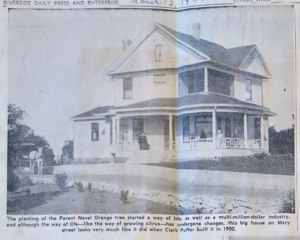
The planting of the Parent Navel Orange tree started a way of life, as well as a multi-million-dollar industry, and although the way of life-like the way of growing citrus- has undergone changes, this big house on Mary street looks very much like it did when Clark Puffer built it in 1900.
Riverside Daily Press and Enterprise, March 12th 1955.
“It was a good life”
Way of Life Has Changed but Old Home Nearly Same, by Tom Patterson
Citrus growing in Riverside has changed in many ways since the first Navel orange tree was planted here in 1873. the method of tillage has changed. The kind of ownership and management has changed. Family life of citrus people has changed, and all of these changes have taken place in an inter-related way.
No single family or single citrus grove could illustrate this very well, but it seemed to me that much of the story was in evidence when I recently visited the home and grove of Mr. and Mrs. J. Edward Lamar at 2732 Mary St., just off Victoria Avenue.
Before long I had also been introduced to Mrs. Jesse C. Puffer, now 88 years old, whose father-in-law planted the grove in 1890, and to Mrs. Puffer’s daughter, Mrs. George Wills, now of 3709 Castle Reagh Pl. To her, the home was grandfather’s house, a place of many happy memories.
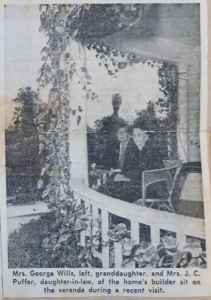
Mrs. George Wills, left, granddaughter, and Mrs. J. C. Puffer, daughter-in-law, of the home’s builder sit on the veranda during a recent visit.
Selected Buyer
When J. C. Puffer died in 1937, without sons to carry on, Mrs. Puffer in her fondness for the home and grove carefully selected the purchaser. The house today still looks like the house in its early pictures. It was built in 1900, 10 years after the grove was planted.
Like many of the other fine old homes in fine old Riverside groves, it was a Midwest home, built by Midwesterners who came here and brought their culture with them-their architecture, their religion, their family-centered outlook and their economy based on family-operated land. (Of course there was a hired man, whose hope was to acquire a position similar to his principal’s.)
No Cards
“My father,” said Mrs. Wills recently, “wouldn’t allow a card in the house on Sundays. My grand-father wouldn’t allow a card in the house at any time.”
Mrs. Willis it attuned to the present, including her bridge club. But recalling my own grandparents, and non-card playing, and the family of that era, I could understand why she allows no scorn to be case upon it. It is easy to make fun of the superficialities of a straight-laced outlook, but Mrs. Wills recalls: “It was a good life.”
Clark Puffer was born in New York state. He went to Nebraska in 1860 and was successful there. The town of Talmadge was built on his land. His son Carrol moved to Redlands in 1889. Clark Puffer followed a year later, renting a house in downtown Riverside and acquiring the 20 acres of desert land on the new Arlington Heights area, on the new Gage Canal, along the new Victoria avenue, whose beautiful future could be seen in its two lanes and its newly planted trees.
Cleared Land
Helped by his hired man, he cleared the land of sagebrush and planted the grove. It was another 10 years before he built the imposing home. He cultivated not only his grove, but Victoria Avenue in the vicinity of it. He and others like him had a large share of responsibility for the stately appearance of that world-famed drive. In 1909 Clark Puffer set out another 10 acres and asked his son J.C to come out from Nebraska. He died in 1913.
J. C Puffer and family moved into the house, where they lived for 25 years. During that time he acquired another grove at Victoria and Monroe, which his daughter Mrs. Wills owns today. He, too, had a hired man, but otherwise it was a family operation.
Died in Thirties
He died in 1937. Carrol Puffer, who had attained prominence in Redlands as a citrus grower and packer, died the following year. Mrs. J. C Puffer sold the Mary street grove to John and Margaret Lamar, children of old friends and fellow orange-growers, the William Farrs. John Lamar is now retired and living in Balboa, but he is still a director of the Gage Canal Co.
J. Edward Lamar, who now lives with his family in the old Puffer home, is in partnership with his brother, Robert F. Lamar of 2080 Grace St. They operate not only six family-owned citrus groves but a citrus spray business with seen heavy vehicles including spray rigs and service trucks.
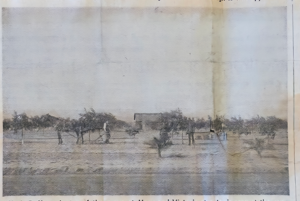
Clark Puffer, planter of the grove at Mary and Victoria streets, is seen at the controls of the spring-tooth harrow when the grove was very young-back before he built the big home on Mary street at the turn of the century.
Studied Citriculture
Ed Lamar graduated from Riverside Poly in 1939, then went to Cal Poly at San Dimas to study citriculture. In the Puffers’ day and in the early Lamar period, horses supplied cultivating power, even when tractors were widely in use. Ed Lamar uses the latest methods and was one of the first to introduce non-tillage, six years ago. While he agrees with the oldtime outlook that “a citrus grove can keep you busy the year around” his routine is that of a business executive, even though his work keeps him outdoors much of the time and he usually wears shoes that can take a scufffing.
The grove needs fertilizing (including bulk fertilizer once a year), pest control, weed control and irrigation. That’s done on a schedule. His job is management, despite the workingman’s shoes.
Life Today
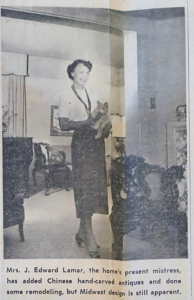
Mrs. J. Edward Lamar, the home’s present mistress, has added Chinese hand-carved antiques and done some remodeling, but Midwest design in still apparent.
I talked with the Lamars and asked them about the way in which citrus families live nowadays and how they operate their groves. As a rule, people don’t do their own work, he explained. Ownership is still on a small scale gernerally. One he knows has 300 acres. Anotehr has 75, but they are exceptions. Those who live on and manage their own groves have tractor work and pest control work done for them, since it isn’t economical to maintain such specialized equipment.
Lamar said it used to be considered that a family could earn a good living on a 10-acre grove. Now the minimum is considered to be 20 acres, but much of the work is done by others. It isn’t the intensive family-centered work project it once was.
He took a mental inventory of his neighboring grove owners: next door, some people who live in Los Angeles; next to that, a grove owned by a carpenter; another by a man who works for the City Light Department, then (who says they’re all gone?) a grove owned by a man who does all his own work.
Then there is a doctor, who primarily practices medicine, and a rancher who combines cattle raising with orange growing, and another who lives on Lido Island, and so on.
Not all Traditional
It shouldn’t be supposed that citrus growing of the old days was all on the Puffer family-centered tradition. The Arlington Heights company and other English firms, who were drawn into Riverside citrus-growing by Matthew Gage, farmed thousands of acres. The tradition of professional management had part of its origin there. In the early twenties the Arlington Heights groves were divided into small holdings. Despite exceptions, grove ownership is still on a relatively small basis. Grove homes, some of them new and up-to-date in architecture, are considered fine places in which to live.
Changes Made
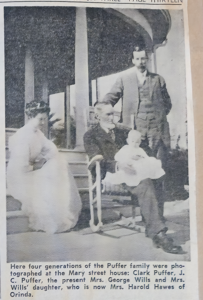
Here four generations of the Puffer family were photographed at the Mary street house: Clark Puffer, J. C. Puffer, the present Mrs. George Wills and Mrs. Wills’ daughter, who is now Mrs. Harold Hawes of Orinda.
The Lamars of Mary Street have made some changes in their home. Old photographs from the Puffer days serve to recall that verandahs were really used then. The Lamars have closed in an upper porch and part of a lower one. (This is Mrs. Lamar’s hobby. She even wieldsd the hammer.) They have modernized the kitchen. They have installed antique Chinese hand-carved furniture into the living room and a Chinese motif at the head of the stairway. They have walled in a verandah door. There are 11 rooms in the home now. There are two children in Lowell School and Mr.s Lamar said: “We really use every single room.” There is a playroom, a TV room, a guest room and a sewing room. The onetime guest bedroom is now Edward Lamar’s office. There is a barn with its hayloft in it.
Sailing Hobby
The Lamars combine a full home-activity life with a sailboat hobby at the beach and with social activities at the Victoria Club. Another family might have revised the exterior more. Another might have rearranged the interior differently. Still another might have limited itself to modernizing the kitchen and air conditioning the rest, confining the renovation to paint and wallpaper and furniture in the original tradition.
But from any of these points of view it seems a good house and a modern life. It is no wonder the Lamars recently opposed a proposed zoning action to permit a shopping center on Lincoln Street nearby. Subdivisions are already creeping towards them from that direction.
6809 BROCKTON AVENUE, RIVERSIDE CA 92506 (951) 961-1609 CALRE#01922817