
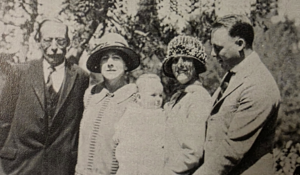
The Spurgeon Family
From the left: Robert Spurgeon, wife Lillian, Grace Brooks and baby Gloria, and Robert Spurgeon, Jr., architect. Gloria Forsyth Photo.
Esther H. Klotz Collection
Robert Spurgeon Jr is a fascinating character in the rich and varied history of this City of Riverside. He did not spend an enormous amount of time here but his impact is lasting and represents a rapid ascent to architectural excellence. He was raised in a wealthy family, the son of a corporate attorney, and therefore had the opportunity to study architecture at Columbia University and then continued his studies at the E’cole de Beaux Arts in Paris, France. He first came to Riverside after the death of his sister’s first husband. Family had brought him to Riverside and once he was here he jumped into the architectural scene with both feet. He took on his first commissions in 1922 immediately working on some large projects like the Pinkerton Estate (now the Cowboy Streets Tract) and several impressive homes on Magnolia avenue. In 1924 he designed one of the most iconic homes in the entire city, not only for its scale and beauty but also for its hillside position that can be viewed clearly from the road that climbed Mount Rubidoux. To this day if you look toward Fairmount Park on the Northeast side of the mountain you can see the home prominently displayed as well as two other phenomenal Spurgeon designs, the Lillian Spurgeon home and the Elijah Parker home both built in 1927. The period from 1924 to 1928 was among his busiest as he was designing some of our city’s most prominent Spanish Revival residential structures as well as smaller homes that were built on speculation, for additional income. He was young and ambitious and so it is no surprise that after getting married he moved to Santa Barbara to be closer to his mother and sister. It wasn’t all family however, as Santa Barbara had declared, after a disastrous earthquake in 1925, that they would rebuild the city entirely in the Spanish Revival style of which Spurgeon was highly skilled. Unfortunately he passed not too long after re-locating to Santa Barbara of a ruptured appendix, he was only in his mid-30’s. Riverside and Santa Barbara were undoubtedly deprived of many potential Spurgeon masterpieces; yet, this very scarcity renders his existing designs even more desirable. Much like Vincent van Gogh, whose death at 37 cut short a legendary career, Spurgeon’s limited body of work has transformed his few remaining creations into rare, highly sought-after treasures.
The following information is taken from Joan Hall’s, “Adobes, Bungalows and Mansions of Riverside, California”
Chapter 88: Architect Robert H. Spurgeon, Jr. and his Mediterranean Styled Homes
Throughout the city of Riverside are 33 attractive houses designed by Robert H. Spurgeon. He often designed and sometimes contracted houses for individuals. He also designed and constructed houses that he later sold.
Robert H. Spurgeon, Jr., was born in Denver, Colorado in 1892. He was the only son of Robert Spurgeon, Sr., who was born in Canada of English parents and trained as a lawyer. In 1886, he left Toronto and settled in Chicago, where he married Lillian McGuire in 1891. After a short period in Denver, the family retuned to Chicago, where a daughter, Grace, was born. Spurgeon, Sr., became a successful lawyer and later, in New York City, served as an attorney for the United States Steel Corporation.
Robert Spurgeon, Jr., grew up in New York City, traveled in Europe and the Orient with his family and friends, and, in 1916, graduated from Columbia University as an architect. He then studied at the Beaux Arts Institute in Paris, France, before joining the U.S. Navy during World War I. He was discharged as a lieutenant in 1918 and went to Los Angeles, where he worked as an architect for two years.
In 1917, Spurgeon’s sister, Grace, married William Lombard and was living in Riverside, but, in 1918, Lombard died suddenly. Grace’s parents came ot California and stayed with her in the Fundenburg house, 2575 Madison Street. They were joined later by Robert, Jr.
In February, 1922, Spurgeon, Jr., designed and contracted five homes and a large 254-by-40 foot stable for Allan Pinkerton, who was building a polo field on his estate at Victoria and Central avenues. The five homes were for Pinkerton’s employees and the stable for his many horses. This is believed to have been Spurgeon’s first Riverside building contract.
During the summer of 1922, Spurgeon was the contractor for an addition to Riverside’s Lowell Elementary School, designed by G. Stanley Wilson. In December of that year, Spurgeon designed and built, for owner, J.H. Flinn, an undertaking parlor with an apartment and garage located on Main Street at Fourth. The permit was for $12,000. This building was torn down when Raincross Square was built in 1975. In 1923, Spurgeon designed three fine homes: the Glen Chapman house at 5012 Magnolia Avenue, the Arthur Holden House at 7355 Magnolia Avenue, and the large house at 4651 Ladera Lane that he built for his parents. In July 1923, blasts shook the rocky hill where the foundation was laid on the side of LIttle Rubidoux. The January 1, 1924 Riverside Daily Press described and illustrated the 14-room house completed for the owner, Lillian Spurgeon, mother of the architect, at a cost of $15,000.
Spurgeon used thick walls, recessed windows, tile roofs, and a decorative central tower. Inside the two-storied house were a large living room with a high domed ceiling, a spacious dining room with a nice view, and a sunroom on the east side. Other beautiful rooms included five bedrooms with three baths and a library. The Spurgeon family occupied the home before December 1923. In that month, a daughter, Gloria, was born to Grace Brooks and her husband, Ralph. They lived in the Ladera Lande house with her parents and her architect brother.
Eldon L. Smith and family owned the house in the 1950s and 60s. He was president of the Citizens National Trust and Savings Bank of Riverside in 1953. The bank merged with the Security First National Bank in 1956 and he became chairman of the Executive Committee. The Smith family added a swimming pool and decorated the interior of the house, which they enjoyed for many years. Later, Anthony Culver and his wife, Frances, lived in the spacious house until his death. She remained in the house until the early 2000s and then sold the property to Patty and Robert Pond. The Ponds had admired the house for many years and were familiar with its history and charm.
In January 1925, Robert Spurgeon, Sr., died at his home attended by his wife, Lillian, and son Robert, Jr. The Brooks family had moved to Santa Barbara, where Ralph Brooks could play more polo and the weather was milder in the summer. During that year, Spurgeon, Jr., designed and constructed a $6,000 winter home for Edward Delafield at 6400 Hawarden Drive.
In May 1925, guided by the original design of Arthur B. Benton, Spurgeon, as architect and contractor, started rebuilding the William Porter house at 5800 Hawarden Drive. The contract was $42,000 to repair damage from a fire and for additional amenities.
Spurgeon designed the attractive house at 4579 University Avenue for which James M. Wheeler was the contractor. Wheeler began construction in December 1925 and completed it for owner Albert Miller for $6,000. Miller, a nephew of Frank A. Miller, worked at the Mission Inn as assistant manager. A year later, at a cost of $20,000, Spurgeon designed and constructed one of his finest homes for Frank Wells at 1945 Arroyo Drive.
The William G. Irving house on Raeburn Drive is another attractive home designed and constructed by Spurgeon. He finished the house in 1926 at a cost of $19,000 and centered it in an orange grove. Irving was city attorney for some years and an able lawyer.
In 1926, Spurgeon was 34 years old, a man-about-town, moving in the best local society, and owning a Cadillac Phaeton. The houses Spurgeon had designed were popular, but probably yielded a limited income. In 1926, he built two small houses at 4864 and 4874 Park Avenue for $3,000 each. These were the first of various homes built on speculation. That same year, Spurgeon drew plans for a pretentious home for Albert E. Hirst and his wife, Emma, built for $13,500 at 4410 Houghton Avenue. Contractor W. J. Nethery constructed the two-story house with stucco and stone, making seven large rooms, many with ceiling beams and tile floors. Hirst owned the Inter-State Fruit Distributors Company. In 1951, he sold the home to Mr. and Mrs. Karl Rauch, who, for many years, owned the Bell Dry Cleaners. In the 1980s, Mrs. Rauch owned the home.
During 1927 and 1928, Spurgeon designed eight houses on Magnolia Avenue. Two are numbered 6895 and 6911 and are just north of Arlington Avenue. Robert Lince was often Spurgeon’s contractor, building houses for $3,500 to $4,000 each. The designs were sometimes unusual with steep roofs, wide chimneys, half timbering, cupolas, or windows with diamond-shaped panes.
Beginning in September 1927, Spurgeon began the construction of two houses at 3080 and 3092 Chestnut Street. He designed and built them for $5,600 each.
That same year, Spurgeon designed a new home for his mother and himself at 4648 Ladera Lane, across the street from the first family home. Robert Lince contracted the home for $10,000 and Lillian Spurgeon owned it. The one-storied house featured white walls, a tile roof, and a circular entrance, flanked by decorative, twisted pilasters. Spurgeon lived there until he left Riverside. His mother sold the large 1923 house to Alfred W. Otis on March 15, 1927.
Spurgeon built many of his homes on hills or near arroyos, perhaps for the view. In July 1927, he began construction of another hillside house for Roberts and Alice Leinau on Pachappa Hill at a cost of $40,000. It is a large, unusual house with a good view. In October 1927, Spurgeon designed an attractive two-storied house built into the hillside at 4631 Ladera Lane. Contractor W.J. Nethery completed the home for owners Elijah and Margaret Parker for $15,000. Parker was a local rancher. Over the years various owners have made some changes to the home. The Philip Fouke family enclosed an upstairs balcony in 1959, Mrs. Shelia Weber built a small pool in 1966, and John and Elaine Coppo, with her decorative talent, made the home beautiful. Mr. and Mrs. Richard Daniel made some alterations to the interior and built a new driveway. In 1981, they graciously opened their home for the annual Panhellenic Home Tour. It subsequently became the home of Knox and Carlotta Mellon.
While the Parker house was under construction, Spurgeon designed and worked with Robert Lince on a $15,000 house for John T. Weller at 4795 Somerset Drive. Completed in 1928, the house was later owned by the lawyer and judge, Fred L. Hamblin.
In 1928, home building declined, but Spurgeon remained busy. In a January 2, 1928 Riverside Daily Press advertisement, Spurgeon described his distinctive homes and announced that, in 1927, he had completed 18 homes, some priced up to $50,000. That same month, Spurgeon designed and built for himself a $12,000 residence at 4736 Indian Hill Road, on the west side of Little Rubidoux. Spurgeon sold the house to Earle C. MacDonald and, in the 1980s, Mrs. Selma Boylan owned it.
Spurgeon first met Betty Van Rennselaar Delafield in 1928, when he built a $1,000 addition onto her father’s winter home at 6400 Hawarden Drive. She was 20, tall, and slender, with dark hair and large beautiful eyes. Spurgeon married her on June 22, 1929, at her family home in Darien, Connecticut. That month, the young couple settled into a house in Santa Barbara, near the home of Spurgeon’s sister, Grace Brooks. Here, their first son was born.
Spurgeon later returned to Riverside to construct two more homes. He borrowed $5,850 in March 1930 from the Pacific States Savings and Loan Company to finish a solid $10,000 house at 4670 Ladera Lane. It was to be sold for profit. The house stood vacant for some time, but Charles Brague of the Lyon Creamery Company was the first owner to live there. In 1940, Brague sold the house to Dr. and Mrs. Alex Melander. Later, their son Ivar, a well-known local musician, owned it.
Spurgeon designed his last Riverside house for lawyer Herbert L. Thompson and his wife, Margaret. She was the daughter of Franz Hosp, a fine landscape architect who designed the garden. The Cresmer Manufacturing Company built the large house at 2301 Arroyo Drive for $15,000. Grace and Donald Drayson later owned it, followed by their daughter Darlene Nemer, who sold it to Dean and Susan Irving.
In 1930 Spurgeon designed three houses: Oaklodge at 777 Romero Drive, Montecito, built for his sister Grace Brooks and husband at a cost of $150,000; a house built for Mrs. Dietrich, address unknown; and a home for his wife, son Robert, and himself located on Hotsprings Road in Montecito.
Another son, Edward, was born on May 22, 1931. Five weeks later, architect Robert Spurgeon, Jr., at age 37, died on July 1, 1931 at the Cottage Hospital in Santa Barbara of a ruptured appendix after an operation. Funeral services and internment were in Riverside.
Spurgeon’s widow, Betty, took her two small children to live in Darien, Connecticut to be near her family. His mother, living in Riverside, was heartbroken, but was comforted by Gloria Brooks, then eight years old, who was sent to live with her grandmother for a year. Ralph Brooks administered Spurgeon’s estate and on December 31, 1934 sold the house at 4670 Ladera Lane to Charles Brague and wife for $6,500. Other property was liquidated and loans paid off. About this time, Spurgeon’s mother, Lillian, moved to Santa Barbara, where she died in 1968, aged 91.
The Riverside homes designed by Spurgeon are highly desirable. They are more decorative than others built during that period and may be identified by such details as twisted columns, cast ornaments, wood or wrought-iron railings, wide chimneys, cupolas, tile roofs, exterior porches, and unusual sites. Riverside has been enriched by Spurgeon’s work. If he had lived longer, Santa Barbara too would have benefited. Unfortunately, Robert Spurgeon, architect, is little known there.
6809 BROCKTON AVENUE, RIVERSIDE CA 92506 (951) 961-1609 CALRE#01922817