
Quite frequently, clients of mine and vintage homeowners often spend time researching their properties’ histories, specifically seeking information on the original owners, architects, and the families who lived there before them. In this case a previous owner of the Lowentrout Tudor Revival on Mount Rubidoux Drive had researched and written about the home’s architect, Welmer P. Lamar. I have pasted the document here word for word and want to thank Katherine for sharing it with us. If you live here in Riverside and have done so yourself I’d love to sit and talk with you about the home and it’s history, reach out anytime. Thanks!
Preface
Often when Riversiders ruminate on the local architects who have designed many of the iconic structures that grace our historic streets, their minds turn to G. Stanley Wilson, Henry L.A Jekyll and Robert Spurgeon. But indeed, Welmer Lamar, contributed mightily to the bevy of Riverside’s early timeless buildings. Very little has been written about him, and he lived a relatively short life. In the short span of his 20 years, as architect of record, he designed nearly 60 structures or substantial remodels, that we know of. Although he designed some beautiful houses for some of the most prominent people at the time, he crossed over to public buildings as well. It was a time when Riverside was growing at a very quickened pace and such design styles as California Bungalow, Mission Revival and Spanish Revival were all the rage.
Considered a prominent architect in his time, his story has never been immortalized and time has not been his friend in that regard. Many of his buildings, especially public buildings, have been torn down and his memory has faded beyond a paragraph or two. Even his obituary was short. My hope is to bring him back to life as he is truly due his place in Riverside architectural history.
California Beckons
Welmer arrived in Riverside either in February or March of 1902 at the age of 15. He was born on April Fools Day, in the year 1886. His life began in the historic town of Shepherdstown, West Virginia. Sherpherdstown sits across the Potomac river from Maryland and is, to this day, considered the oldest city in West Virginia.
Welmer was the 5th child and 4th son born to his father, Richard David Sr. (1850-1934) and his mother Sarah (1853-1943). Richard and Sarah had in total seven children, five of whom survived by the time that they moved to Riverside from their original settlement in San Diego.
It was in either 1891 or 1892 that the Lamar family began their westward journey from West Virginia to California. Their first stop being San Diego, California. Welmer was a mere child of 5 years when he arrived in Southern California. In 1900, the census listed the Lamar Family as living at 733 D. Street in San Diego His uncles owned a shoe shop and according to the 1900 Census Report Richard “Dick” Sr., Welmer’s father, was listed as working in the retail shoe business in San Diego.1 He later joined Marston Enterprises, where he was part of the shoes branch. When he left San Diego for Riverside he claimed to have worked in “shoes” for around 15 years, so perhaps that was his profession in Virginia as well.
Tragedy struck the family twice in San Diego; Border, the eldest son, was 21 when he died in the home of his parents of typhoid fever on Saturday, July 18 1896. Clara, their second child and the only girl, was 20 when she died 2 years later in 1898. Losing a child at such a young age is a heartbreak for any family, losing two has got to be an emotional burden hard for any parent to bear. Perhaps it was for this reason that Richard Sr. was open to being uprooted from The Bay City with its near perfect year-round weather to Riverside with its scorching summers when GN Reynolds came knocking. Records show that, indeed, Richard Sr. moved to Riverside sometime in 1901 to manage the shoe department at the GN Reynold’s Store and his family followed sometime in February or March of 1902 to take up their residence in Riverside.
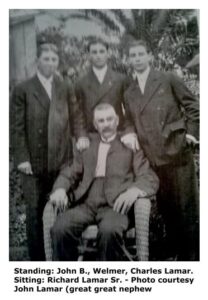
At that time two of the children stayed behind in San Diego.
- Richard Lamar Jr. (21 years of age at the time of the family move)
- Daniel S. Lamar (18 years of age at the time of the family move)
Richard Sr. had temporarily secured a house at the corner of Market and Eleventh.2 Of their five living children three moved with their parents to Riverside in 1902.
- Welmar P Lamar (4.1886-1933) born in West Virginia
- John B. Lamar (2.1889 – 1973) born in West Virginia
- Charles B. Lamar (5.1893 – 1968) born in California3
Eventually the Lamar family settled at 876 8th Street (now University Street) which is where Welmer, along with his parents, called home until the end of their lives. The Lamar family was considered part of the Riverside prominent set, Welmer included.
Although his personal life remains somewhat a mystery and so much is unknown except that he was, according to his World War I draft registration card, of medium height, with a medium build, brown hair and blue eyes.4 When Welmer arrived in Riverside at the age of 15, he would most likely have attended Riverside High School, which at the time was a new co-educational high school building that was constructed on Ninth Street between Lemon and Lime.
There was a certain amount of fluidity between San Diego and Riverside for Welmer and his siblings but by and large the children that moved with their dad to Riverside ended up making Riverside their permanent home. Conversely, Daniel S. and Richard Jr. who stayed in San Diego when their father moved to Riverside ended up in San Diego, eventually making it their forever home. Both Welmer and John B. moved to San Diego for a short period of time before ultimately making their way back to Riverside and John B. spent considerable time in Riverside before migrating back to San Diego.
On becoming an Architect
Welmer’s initial post-high school endeavor was at the Loring Theater, eventually setting his sights on San Diego in the 1905 -1906 timeframe. In San Diego, according to the City Directory, he assumed the role of draftsman under Clements & Blachmann. It is unknown if Welmer showed a natural proclivity for the field of architecture or what the specifics of his professional qualifications were, but it was clear that he had an artistic eye as can be seen in the drawing by him of the San Diego Sherman Heights School. The drawing is dated May 2, 1900, when he would have been only 14 years old Given his choice of subject matter, it is possible that Welmer’s interest in architecture blossomed at a young age as well.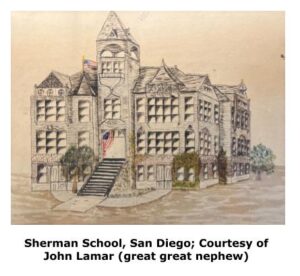
His employment in San Diego with the architecture firm was short lived, not because of him, but rather the company had a very tumultuous tenure due to the three partners. The partners had the makings of a successful endeavor as they were all established architects; G. C. Clements, (president) J.B Stannard (vice president) and Edmund Blachmann (secretary and treasurer) under the name Clements, Stannard & Blachmann. They were located at Suites 32, 33, and 34, Keatling Block @ 5th and F streets, San Diego. Before 1906 came to a close, J.B. Stannard had already parted ways with the firm, causing quite a stir. The San Diego Union made sure to highlight his exit, noting that “Mr. Stannard to open an office for himself. He has been in business in this city for many years, and had established an enviable reputation before entering as member of the partnership which is now about to dissolve.” The dissolution of the partnership led to the firm being listed as Clements & Blachmann.
The revised iteration of the firm, helmed by Blachmann, faced a similar fate; meeting its end in May of 1907 through mutual agreement. Blachmann took charge of continuing the business operations and ensuring all outstanding debts were settled. Shortly thereafter, Mr. Clements embarked on his own tumultuous journey when his close friend tragically took his own life. The friend’s despair over his unfaithful wife led him to plead with Clements to safeguard his four-year-old child in case the mother proved unable to care for the youngster. The ensuing ordeal unfolded in a protracted and draining manner, casting a shadow over all involved.
Mr. Blachmann, it seems, did not fare well either and apparently, as could be deducted when applying for the position of city architect after his departure from the firm, he was met with enough reputation damage that it kept him from acquiring the position. It can be assumed that the damage was extensive as it appears that he left San Diego and no further info can be found on him in the city newspapers after that date.
A Forever Home by the River
Perhaps this was all too burdensome for Welmer, following in his father’s footsteps by seeking solace in the embrace of Riverside. While this may be mere speculation, the truth is that in 1908, Welmer made the decision to depart and head back to Riverside, where he secured a role with S.L. Pillar, a well known figure in Riverside’s construction landscape. Welmer, aged around 23 or 24 upon his return, aimed to carve out a new path in familiar surroundings.
In portraying Welmer’s architectural legacy in Riverside, one must delve into the narrative of S.L. Pillar. While Pillar’s expertise leaned more towards the construction realm, he was an entrepreneur and opportunist by nature. It is within this framework that Welmer refined his craft, likely first serving as a skilled draftsman and eventually as contributing talent in design because Pillar’s wheelhouse continued to remain on the building side. Together, they collaborated on various projects, with Pillar being credited as the architect-of-record
Born in Ottawa, Canada in 1866 Mr. Pillar came to Riverside in 1887 on an excursion train. He was then 21 and already an established carpenter. He was, for a number of years, a foreman for John E. Porter – a contractor who had erected some of Riverside’s best buildings at that time. The Loring Block, The Presbyterian Church and many others were built by him under Mr. Pillar’s direct supervision.55
Eventually Pillar went out on his own and in 1906 he formed a partnership with W. G. Suits who himself was engaged in the carpenter business for twenty years in Riverside. At the time they formed the partnership Mr. Suits had been Mr. Pillar’s foreman for several years. The new company purchased outright the machinery and stock of a company called the Art Novelty Company, which included a great deal of art novelty stock. The intent was to engage solely in the manufacture of such items.
Besides the art novelty feature, the new company engaged in the manufacture of ladders of all descriptions. Since they could be manufactured locally the company always had on hand a large assortment for those subject to need. Such ladders were particularly useful to those involved in citrus farming. They could generally get custom made ladders on short notice, but those covered by patents were carried in stock.
Mr. Pillar still continued his construction business. Early on he had the foresight to get his certification in architectural design. In 1901 he officially became a licensed architect by studying and passing the examination.6 As noted in the Riverside City Directory, he was the first person in the city to be listed with the title of architect. Always an opportunistic and enterprising man perhaps he got his certification for that very reason. Promoting himself as a certified architect he, however, thrived primarily in the field of construction.
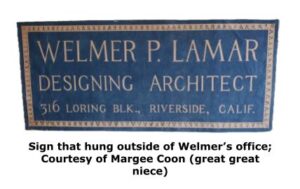
When Welmar returned to Riverside to ostensibly continue his “tutelage” under Pillar It was most likely a union of convenience and a partnership forged in practicality as Pillar had the established connections and academic insights into the field. But it was Welmer who most likely had the design acumen. The extent of Pillar’s hands-on design involvement remains uncertain. Evidence to support this speculation that Pillar was not involved in the design itself, was further solidified when he was cited in the press declaring his intentions were to only oversee his newly founded architectural firm. Subsequently, his title as a supervisor appeared in the city directory at that time. In contrast, Welmar chose to forgo formal architectural certification, entering the field through apprenticeship. In those days architecture apprenticeships were just a different way into the field and were commonly accepted as a legitimate entry into the field.
Shortly after Lamar joined with Pillar another architect was seduced by those heady days of Riverside’s rapid expansion. His name was Henry L.A. Jekyll and his imprint on Riverside architecture has become legend and a masterclass in elegance and groundbreaking design.
The complexity of Pillar’s awarded building contracts soared when Jekyll joined the company in 1909. Similar to Lamar, Jekyll also lacked formal architectural certification – opting instead to get an engineering certificate. Jekyll’s expertise in designing skyscrapers on the East Coast was a significant asset to the ambitious Pillar. The combined sensibilities of Jekyll and Lamar heavily influenced the houses credited to Pillar during that era, leading to the belief that Jekyll primarily handled engineering and design, while Lamar focused on design and drafting responsibilities. The knowledge Welmer gained from Jeykll was undoubtedly priceless.
During this period, Welmer’s name frequently appeared in the society columns due to his active social life. Known for his reserved nature, witty sense of humor, and penchant for luxury, he was a familiar face at numerous social events. One notable incident worth mentioning is the tragic poisoning of his beloved Scotch Collie, Ormskirk Emerald III (affectionately called Sandy). 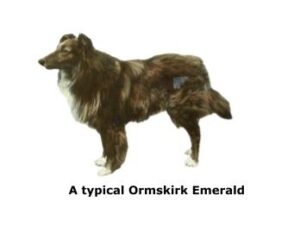 Sandy held significant value, as his lineage traced back to the esteemed Ormskirk Emerald Jr. and Wellsbourne Happy Medium. The impressive pedigree of the collie is evident in the fact that his grandsire fetched $7,000, while an Ormskirk Collie was famously sold for $8,500 in San Francisco four years prior, a breed that even caught the eye of Queen Victoria.
More and more Welmer’s name gained recognition in the newspapers not for his social engagements, but for his involvement in architectural design projects. He was steadily making a name for himself as a prominent architect in Riverside. By 1912, Jekyll left the firm, leading Welmer and Pillar to establish a more integrated partnership, presenting themselves as a unified architectural design firm. One of their initial joint ventures was a bid for the Elks Club in Riverside, proposed to be situated at the intersection of Market Street and Whittier Place. Despite the project’s cancellation for unspecified reasons, it highlighted Lamar’s increasing acumen in the field as the project was quite significant in its complexity. Another significant project the two embarked on was the construction of a two-story basement building on Tenth and Main.
For whatever reasons Lamar’s association with Pillar seemed to fade almost as soon as it began, they did share offices located in the Loring Building on what is today 699 Main Street. Lamar’s office was in Room number 316. Lamar collaborated with numerous local builders and showcased his versatile skills by designing a range of architectural styles such as Tudor, Craftsman, California Bungalow, Mission, and Spanish Revival. His portfolio was diverse, featuring various types of buildings including apartment buildings, public structures, churches, remodeled storefronts, fairground bleachers and booths, and private residences.
As an article cannot do justice to the multitude of Lamar’s architectural achievements, a comprehensive list can be found in the addendum. While many of his commercial designs have vanished, his residential creations still stand strong. Included in a second addendum are photographs showcasing a select few of these enduring houses. Should you or anyone you know have further information on any of the buildings please contact Vince Moses, Riverside Historian at vincate@att.net.
Epilogue – A Family Affair
In and around 1908, John B returned to San Diego and together with his brother Richard Jr., established Lamar Brothers Shoe Store in emulation of their father, as Richard Sr. still managed the Shoe Department for GN Reynolds in Riverside. However, by 1913, Richard Sr. and John B opened The Lamar Shoe Store on 673 Main Street in Riverside. This location was the same as Welmer’s architectural office – The Loring Building. Charles later joined the Lamar family. The store continued operating until the passing of Richard Sr. in 1934.
Only Daniel remained in San Diego for his entire life and was in the real estate business.7 By 1930 Richard Jr. had returned to San Diego and per the 1930 census, both Charles (age 36) and Welmer (age 44) were living with their parents in Riverside.8 Three years later at the age of 47 Welmer passed away. On a sober Saturday Oct 7, 1933 his demise was ascribed to Pulmonary tuberculosis and acute arthritis, with his death certificate citing additional significant contributory causes such as myocardial regeneration.
Funeral services were conducted in the chapel of Acheson and Graham on Oct 9, followed by his cremation @Evergreen Cemetery, the same day. His ashes were interred at Mount Hope Cemetery in San Diego along with the remains of his brother and sister who had passed before him several years earlier. One year later his father joined them in the great beyond at the age of 84. Welmer, who was living with his parents at the time of his death, never married and had no children.
Addendum II: small sampling of Lamar designed homes
Endnotes
- Ancestary.com Source Citation Year: 1900 Census
- Riverside Daily Press, Volume XXII, Number 258, 24 January 1902
- According to the Census report for 1900 Charles was listed as 7 years old making it likely that the Lamar’s migrated to California sometime in the late 1890’s
- See Ancestry.com, Source Citation Registration State: California: Registration County: Riverside; RollL 15312775 Draft Board: 1
- Riverside Daily Press Sat, Octt 06 1906
- Adobes, bungalows, and Mansions of Riverside, Revisited by Ester H. Klotz and Joan H. hall pg.342
- US Census Report 1920. That year Welmer was listed as an aerialist and his name was spelled “Wefmar Lamar”
- US Census Report 1930 Welmar was listed as a Draftsman working for the Electric Power Co. He was also listed as Wilmer LaMar and several of his family members were now using the spelling “LaMar” as their last name.
6809 BROCKTON AVENUE, RIVERSIDE CA 92506 (951) 961-1609 CALRE#01922817