
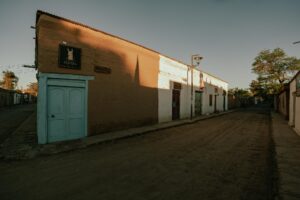
Streets of San Pedro de Atacama at sunrise
The Long Road South
The Atacama Desert turned out to be one of the most visually captivating places we had the chance to visit. From the unexpected and vibrant colors to exotic wildlife, the desert continued to surprise and enchant us with its beauty. We first heard about this place from a Bolivian girl we met while visiting the remote island of Palawan in the Philippines—another place of stunning beauty. It was a journey to reach Atacama, and not a particularly nice one. Since we were in Arequipa, we first had to fly to Lima, where we transferred to Santiago, the capital city of Chile. Santiago was not a great experience. We’ve been to many rough cities, been around poverty and “projects,” but rarely has there been such a palpable feeling of danger. We stayed in a typical airport hotel with a free shuttle back and forth, but with the downtown core only a 20-minute drive away, we decided to visit and look for something to eat. As we got closer to the city and traffic started to build, the driver told us to roll our windows up. He said that it was common for thieves to reach into the car and try to take bags, phones, or other items of value. He warned us to keep a close eye and not to stay out past sundown. As the stores began to close, we noticed them barricading the doors and windows with steel bars or steel
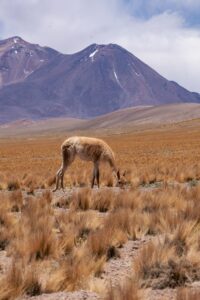
Wild Vicuna grazing
roll-down doors. Many shops even had bollards out front to prevent break-ins using vehicles. We passed a coffee shop and went in to use the restroom. After ordering a coffee, we looked around and noticed scantily dressed young girls and middle-aged men—more like a strip club than a coffee bar. It was very strange, and that combined with the trash piled up on the street had us grateful we were only spending one night. I don’t even remember what we ate, but we were conscious to get out of there before sunset, only spending 3 or 4 hours downtown.
The next morning, we were on a flight to Calama, which was far better than Santiago, though still not with much to see. We had rented a car to explore the desert, and since it was morning, figured we’d drive around a bit in Calama. Narrow streets of very simple concrete buildings define much of what we saw, so after about an hour, we decided to make our way to the town of San Pedro. Getting out of the city and through the early parts of the desert was ugly. Trash and rubble lined the streets, and it felt more like Adelanto or Victorville than this incredible desert we were expecting to see. Things changed dramatically, however, as we approached the fertile town of San Pedro. We began the descent into the valley and noticed off to the west the Valley of the Moon and its stunning rock formations; we had arrived.
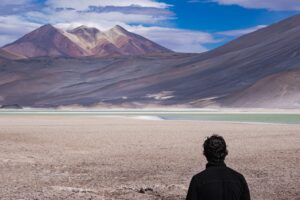
Piedras Rojas and the salt flats
Vivid Colors and Abundant Life
This desert is documented as the driest place on earth, which could lead to the assumption that it would be barren and lifeless. Water is life, and there is almost no water here—only half an inch per year on average—but life is resilient and so incredibly adaptable. We saw many wild birds, most notably flamingos with their vibrant pink, red, and white bodies. We saw llamas, vicuñas, foxes, and even a pair of wild rheas. The plant life was varied, from prickly cactus to drought-tolerant shrubs and grasses, and these were set against expansive and colorful desert rock. It was truly amazing to see just how colorful this place was, a palette of neutral tones starkly set against a pristine blue sky. There were many shades of pink, purple, yellow, orange, and red. The pastels of the mountain peaks would blend into the bleach-white salt flats or mix with the sun-baked desert floor. We would drive a while, sit and enjoy the views, drive some more, and generally just explore this massive expanse of desert.
We had a relaxing week there in the desert, exploring the high-altitude saltwater lakes, sitting and watching the flamingos come and go in large flocks. It was so silent there, and with very little tourism outside of the Valley of the Moon, it was easy to feel a part of the landscape and just witness this small slice of the world. One morning we visited the Tatio Geysers, waking up early and driving several hours on rough dirt roads to get there. They said the morning was best as it would be cold and the geysers more spectacular. I remember my fingers and toes going numb, but that didn’t take away too much from the experience. The geysers, similar to caldera fumaroles, really bring your awareness to the power of our planet’s core. So often we walk around on the thin earth’s crust without much consideration given to what is going on below us. With the swirling, spitting, steaming geysers, you can’t help but appreciate the earth’s engine, and it’s a humbling experience.
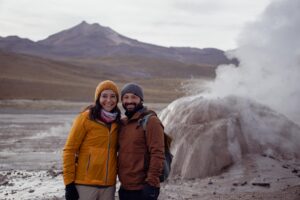
Tatio Geysers
Not perfect but who needs perfect?
I’m embarrassed to say that we had gone to visit this desert specifically for stargazing, but I really wanted to see the town of Arequipa and thought a few days’ delay wouldn’t be a big deal. Well, if you’ve ever given consideration to moon phases, they change quite rapidly. The difference of just four days meant a fairly significant gain in light pollution from the waxing moon, and so our evening to stargaze unfortunately wasn’t as good as I had hoped. It still was a great experience, very educational, and we were able to see many stars as well as Saturn with its incredible rings. With travel, especially long-term travel, things don’t always work out perfectly, but we still had an incredible time.
Indeed, our world
The following day, we decided to visit the Valley of the Moon, which is by far the most touristed place in Atacama. There is a reason for this, however, and this valley absolutely blew our minds. We had never been anywhere like it, and this place truly felt otherworldly. I find that term interesting, because every time I want to use it, I think to myself: this is indeed our world. I think it just goes to show how little we get to see of our world with our own eyes, and the more we see, the more we appreciate the different “worlds” that make up planet Earth. There were enormous dunes of smooth, spotless sand carried by wind over millennia.
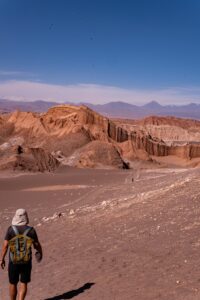
Walking in the Valley of the Moon
The perfect curvature of the ridge set against the jaggedly carved cliffs below was a sight I’ll never forget. Incredibly intricate and seemingly delicate rock formations, steep cliffs, and ragged ridges shaped by wind rather than water formed a landscape unlike any other. We drove from section to section, and they have it set up quite well with short loops around prominent features. It was a wonderful afternoon, and as the day wore on, we made our way to a great sunset viewing location. As the blue sky faded, the cooler tones cast across the sand warmed to an orange glow. The last rays of light crested the jagged peaks, and shadows stretched and swirled through the landscape’s many features. We smiled from ear to ear knowing, even in that moment, that this view would live long in our memories.
Adobe, everywhere.
As a self-taught student of architecture, the town of San Pedro de Atacama was a wonderland. Nowhere else have I seen an entire town built of adobe. The walls, houses, and business buildings were all adobe; even the roofs were made of mud. The foundations appeared to be made of boulders, and many walls throughout the village were constructed from rock—some covered in adobe, others left naturally exposed. The sidewalks were hand-carved stone, and the streets were dirt. It was simple, and simply perfect. The church was among the most beautiful I had ever seen, even in comparison to European cathedrals. Completely built of adobe, with exposed rafters of cardón lumber, whitewashed plaster walls, and unique desert details.
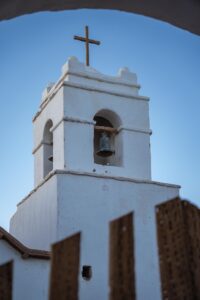
Iglesia San Pedro de Atacama
For example, most Catholic churches have a font, or stoup, located at the door for believers to dip their fingers and remember the sacrament of baptism. I have seen these made of marble or gold; most notably, in the Cathedral of Santiago in Spain, there is an incredible carved scallop shell representing the end of the arduous Camino de Santiago. In this church, however, the font was simply a clay jar inset into the wall. The same purpose, the same meaning—simplified. My favorite aspect, however, was the gates and fences made of madera de cardón. These come from high-altitude cacti that grow into massive columns and stand out in the desert landscape. When they dry out, they feature a distinctive crisscross pattern and are often tied together with wet llama rawhide that draws tight as it dries. We were able to bring a couple of bowls home made from this material, and they are an excellent reminder of our week spent in this beautiful desert paradise.



6809 BROCKTON AVENUE, RIVERSIDE CA 92506 (951) 961-1609 CALRE#01922817